
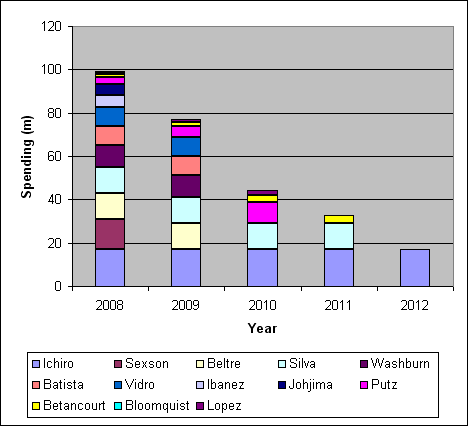
Mariner payroll commitments, 2008-2012
DMZ · December 21, 2007 at 10:43 am · Filed Under Mariners
Drawn from CoT. Does include Vidro’s almost-certain-to-vest 2009 option he got in the trade from the Nationals. Does not (not) include mutual options, speculation about players headed into arb, and so forth.
Comments
71 Responses to “Mariner payroll commitments, 2008-2012”
Leave a Reply
You must be logged in to post a comment.
You bring up a good point, pitching should follow a different (sic) paradyne and should be broken out separately. IMO, spikes in payroll are welcome in the bullpen because pitching follows more closely to individual, rather than team building principles.
You realize, of course, that the effective pitchers in the 2007 Mariner bullpen basically consisted of JJ Putz and a bunch of guys making MLB minimums, right? And the “proven veterans” who made more than that (Rhodes, Reitsma, Parrish and White) were basically useless and contributed nothing to the team?
The problem with ‘comparatively’ overpaying for your “superstars†(at the Mariner’s budget level) is that you gamble way too much on their being really good. Replacing them becomes more and more impractical and prideful in SOME cases; and your ‘median’ players are not good either as a result.
So, the logic is to gamble that mediocre-to-good players will be good and retain their abilities, instead of gambling that superstars will retain theirs?
For an example, let’s take two group of 4 arbitrary players, with the amount of runs they can be expect to add on offense/prevent on defense or pitching above an average player:
Player A: +40 runs, 15 million in salary
Player B: +30 runs, 10 million in salary
Player C: 0 runs, 350K in salary
Player D: -10 runs, 350K in salary
Total: 25.7 million, 60 runs
Player E, +15 runs, 6.4 million in salary
Player F, +15 runs, 6.4 million in salary
Player G, +15 runs, 6.4 million in salary
Player H, +15 runs, 6.4 million in salary
Total: 25.6 million, 60 runs
Now, let’s assume that our replacement players are -10 runs and will also make 350K. If injury strikes players C or D, it’s not a huge problem. If it strikes A or B, big problem. If E, F, G or H go down, though, it’s a pretty large problem, if not as large as A or B… and, to boot, AGING is also a factor- if E,F,G,H lose 20 runs of value in a season they become BAD players, whereas if A or B lose that, they are still above-average (they have a higher peak to decline from).
Spreading your salaries around to more of baseball’s “middle class” makes you vulnerable in more places to having age-related decline/injury/etc. Now, if you are the Yankees or Red Sox, no big issue, you just sign somebody else and let Giambi or Williams age on the bench… but the M’s aren’t.
Gwangung:
Pitching. I believe we are arguing the same point about. I used the bullpen ubiquitously, as meaning the whole pitching staff…. I maybe should have said that in my world starting pitchers would be the highest paid players on a team, and can justify bigger spikes in payroll there.
I am not making it hard; I just understand team psychology and dynamics better than most, and feel worth the time to give my two cents.
Not even saying a team should not go after superstars, but I too, am leery as to what Bavasi would consider to be a “superstar.†He/they need checks and balances…a median formula serves in this regard and guards against overspending for mediocrity.
eponymous :
ditto; the bullpen thing. I meant the entire pitching staff, whereby, if spikes in payroll represent “horses†out there on the mound, I am all for it.
During the ‘Gillick years’ the team’s median salary rose to its highest ever. In fact, the M’s lead the league in median salary for a couple of those years. I personally think Pat had a handle on that aspect of team building and I don’t think he was lucky.
Also if you will remember, when we lost a superstars like Griffey, Rodriguez or even Johnson (hate to loose good pitching) the team reloaded and went on to even better records the years following each superstar’s departure, respectively.
So the M’s have a recent history of playing better when the superstar does go down or goes away.
Asked whether the Tigers should sign A-Rod, Tiger GM Dave Dombrowski pointed out that no team has ever won a World Series while paying more than 17% of its salaries to one player. Makes a certain amount of sense . . .
In 2003, Pudge Rodriguez earned 20.5% of the Marlins’ payroll, which is humorous because most of that team was made up of players Dombrowski acquired before he left. I guess he immediately stopped paying attention to his former team and didn’t notice that they went out and won the World Series with one highly paid superstar and no one else making even half his salary.
Also, in 2004, Manny Ramirez earned 17.7% of his team’s payroll. I know, it’s seventh-tenths of a percentage point, but still, it’s more than 17%.
We are probably working from different sources, but I show Manny at $20.5M for 2004 with a team payroll of $127.3M which works out to 16.1%.
I was working of the USA Today salary database, which shows Manny at $22.5 million for 2004. So I assume you’re looking at Cot’s, which lists a $20.5 base salary, but I’m guessing he earned some of the bonuses that are listed in his contract? I’m really not sure. If I’m wrong, that’s cool. I mostly wanted to point out the Pudge figure.
In 2003 the Marlins median payroll was near the top at fifth, while their overall payroll was near the bottom. Boston is always near the top in both categories.
During the ‘Gillick years’ the team’s median salary rose to its highest ever. In fact, the M’s lead the league in median salary for a couple of those years. I personally think Pat had a handle on that aspect of team building and I don’t think he was lucky.
It worked OK for a number of reasons, but the 2004 collapse is also something his strategies contributed to- which, by the way, was historic (going from 93 wins to 99 losses in one year).
Also if you will remember, when we lost a superstars like Griffey, Rodriguez or even Johnson (hate to loose good pitching) the team reloaded and went on to even better records the years following each superstar’s departure, respectively.
Uh, going from 76 to 79 wins in Johnson’s case was pretty marginal, and Gillick wasn’t here for that, was he?
And yes, the Mariners did some good personnel management. They also got to expand the payroll in 2000 and 2001. Some of the players they added were also VERY good: Sasaki, Boone, Cameron, Olerud and Ichiro.
And again, 2001 isn’t very “recent”. “Recent” history is Carl Everett, Jose Vidro, Scott Spiezio, Jarrod Washburn and so on, in a failed attempt to recreate Gillick’s 2000-2001 drawing to an inside straight on the free agent market.
Blaming Gillick for 2004? No chance, not given his track record of building winners -vs- Bavasi’s record of building colossal meltdowns. No, Bavasi is responsible for 2004 – that’s a no brainer.
Johnson left in 1998, leaving the 1999 Gillick team to adjust to the loss of the best pitcher in baseball and team history. BTW, Gillicks first year saw payroll drop twelve-million dollars.
“Recent” – meaning the Seattle market is still the same size and payroll comparisons are still valid.
Lucky or Good – I’d take Gillick back in a heartbeat.
Blaming Gillick for 2004? No chance, not given his track record of building winners -vs- Bavasi’s record of building colossal meltdowns. No, Bavasi is responsible for 2004 – that’s a no brainer.
Hehe
In 2003, Pudge Rodriguez earned 20.5% of the Marlins’ payroll, which is humorous because most of that team was made up of players Dombrowski acquired before he left. I guess he immediately stopped paying attention to his former team
Well, I guess you can say he was wrong about Pudge’s salary in ’03. But you can hardly accuse the guy of not paying any more attention to the Marlins, considering that Pudge, Cabrera, Willis, Rentaria and Jones are now Tigers–the Marlins have been migrating northward . . .
Blaming Gillick for 2004? No chance, not given his track record of building winners -vs- Bavasi’s record of building colossal meltdowns. No, Bavasi is responsible for 2004 – that’s a no brainer.
Go look at how many of the players in 2004 who had terrible seasons were signed/acquired under Gillick as opposed to Bavasi.
I’m not saying Bavasi is a better GM, but many of the problems Bavasi encountered in 2004 predated him, because the Mariners basically were keeping their Edgar/Boone/Wilson/Olerud core around too long, until they were no longer able to be productive players.
One might also notice that all three of Gillick’s teams melted down very badly after he left. My argument would be that Gillick’s very good at jumping out of the car as it goes off the cliff, and the Phillies better watch out in 2009.
Johnson left in 1998, leaving the 1999 Gillick team
<A HREF=”http://www.baseballamerica.com/today/execdb/showperson.php?fname=Pat&idx=GilliPa01&lname=Gillick”Gillick was hired AFTER the 1999 season concluded.
Lucky or Good – I’d take Gillick back in a heartbeat.
I will agree that he’s considerably better at free agent evaluation than Bavasi is.
well $6-9M of that was not paying RJ …
Team chemistry. It runs through the team, the manager, the staff all the way to the FO and GMs. Confidence in the GM is critical for any team to succeed. I have to think that had Gillick been there in 2004 the season would have turned out better. But there is no way to honestly argue either position.
Sorry, my two separate databases had shown – 1999 = Gillick. Anyway, I hesitated to use Johnson to bolster my position because he was a pitcher and nobody in his right mind would want to give up the best pitcher in the league. But that was Woody’s finest hour as ‘the Reluctant Hero’
Wa ha ha ha ha ha ha.
The ultimate in “team chemistry” would be a team where Willie Bloomquist clones comprised the entire organization.
From CEO to batboy? ALL WILLIE, ALL THE TIME.
Team chemistry. It runs through the team, the manager, the staff all the way to the FO and GMs. Confidence in the GM is critical for any team to succeed. I have to think that had Gillick been there in 2004 the season would have turned out better.
So had Gillick been there, Boone, Edgar, Wilson and Olerud would have all been able to hit worth a damn?
Seriously, that’s a very silly argument. GMs do not have magical properties of anti-aging and improving player performance, and 2004 was a clear case of the team being old… and the decisions to put those guys under contract for 2004 were those of one Pat Gillick. In addition, as has been detailed on the blog, Gillick WAS involved in the player personnel decisions.
I don’t think Bavasi is a good GM, but Gillick’s strategies tend to leave the team vulnerable to getting old and bad suddenly, which has happened every place he’s left. Like Auric Goldfinger says: “Once is happenstance. Twice is coincidence. The third time it’s enemy action.”
This is my last post on this topic.
((“GMs do not have magical properties and improving player performance”))
Do you realize that one of the biggest obstacles the M’s face currently in bringing in quality free agents is the reputation of our current GM? Do you not realize that players follow certain GMs because they know they have a reputation of putting together winners? Gillick is one of those GMs. (and no, I did not set out to be a Gillick apologist).
Safe it to say, that you, or any other blogger, have no actual idea as to the extent of Gillick’s 2004 involvement with regards to team personnel decisions, any more than you know who was juicing and coming off inflated numbers that year.
And do not bolster your positions by calling mine very silly, that type of retort makes you sound smug, and I don’t think that is how you want to come off.
Thanks!
Do you have any evidence, at all, for your assertion that free agents won’t come here because of Bavasi?
To quote from the handy-dandy USSM Orientation post linked at the top:
So if you’re going to claim that: team chemistry is a factor in success on the field not only between players, but between the front office staff and players as well; that free agents won’t come to the Mariners because of Bill Bavasi; or that the “bloggers” here are all uninformed hooligans, while not providing ANY evidence to support your assertions…
Expect to get a lot rougher treatment than either eponymous coward’s post, or this one.
Do you realize that one of the biggest obstacles the M’s face currently in bringing in quality free agents is the reputation of our current GM?
No it isn’t. There’s no evidence that this is the case.
Do you not realize that players follow certain GMs because they know they have a reputation of putting together winners? Gillick is one of those GMs.
No they don’t. No he isn’t.
I don’t think it’s smug to say that these are silly opinions, because they are silly opinions.
Free agents don’t turn down the best offer on the table because of the reputation of the GM. Beltre and Sexson didn’t, and they were premier free agents that year — was Bavasi’s reputation any worse then, compared to the new, years-of-improvement Bavasi?
Like him or not, Bavasi’s got a fine reputation as a good guy to deal with, who does the right things for his players — it’s not like Jim Bowden, where there are bitter guys who got screwed on handshake deals around the league.
If you’re ignorant of that reputation, that’s one thing. But to say that something — which isn’t true — is the cause of something that isn’t happening, well, start at the start.
Further: free agents don’t follow GMs.
a) GMs don’t move enough
b) free agents aren’t free agents enough
c) free agents don’t turn down the best offer for one GM over another
What GMs can offer players they’re on good terms with is trust that they’re being brought on for the role they’re told, that they won’t (for instance) be offered arbitration after a short contract, that the terms of the off-contract no-trade will be honored, and so on.
There’s a substantial value to that compared to, say, signing with Jim Bowden (not to harp on him).
But where are these players who prove this point, choosing to pass up superior offers because they want to be on one team over another? They’re not out there.
Free agents pick the best offer, acting in their self-interest. That’s it. That’s all.
Um, allow me to point out that your argument went from:
“Team chemistry. It runs through the team, the manager, the staff all the way to the FO and GMs. Confidence in the GM is critical for any team to succeed.”
to
“Do you realize that one of the biggest obstacles the M’s face currently in bringing in quality free agents is the reputation of our current GM?”
In other words, you’ve changed your argument. Since DMZ and Jeff Nye looked at the second argument, let me clarify why I disagree about the first, and then come back to your new argument.
I find the idea of GMs being able to eke performance out of players through nebulous “team chemistry” to be ridiculous- the concept is mainly a backwards-looking idea of “well, they must have had chemistry because they won”. What GMs do is make sound or unsound player personnel and management decisions, and that is how we evaluate them in any sort of systematic manner. It’s fairly obvious that the Mariner loading up on FA veterans and the remnants of the 1995 team was going to come back and haunt them at SOME point, and 2004 was that point. Gillick did not leave Bavasi with much in the cupboard to deal with that. Therefore, I think it’s eminently fair to hold him responsible in part for 2004.
The problems with the 2004 team (which is what we are arguing about) had not very much to do with Bavasi’s ability to bring in quality free agents- the roster was mostly set (recall the 5 man rotation that had been in every start in 2003). The major additions were Spiezio, Guardado and Ibañez (one big flop, one injury-plagued player who was still good for a while when healthy, one very solid signing, and before you say that Gillick would have done better, James Baldwin and Jeff Cirillo say “Hi”)- and recall that Pat Gillick was on the payroll ADVISING Bavasi, Armstrong et, al. in 2004.
You know, I’m fine with being smug in the face of grossly incorrect arguments.