
Game 141, Angels at Mariners
Mike Leake vs. Ricky Nolasco, 7:10pm
Time is growing short, and the number of teams the M’s need to hurdle is long. They’ve got to play nearly perfect baseball from here on out, and they still don’t have Felix or Paxton back yet. Stabilizing the rotation was why the M’s picked up Mike Leake, and to his credit, he was far better than advertised in his first game out, striking out 7 Oakland A’s in a convincing win. The M’s are going to need more of the same, and having another such performance against a much better opponent – like the Angels – would go a long way towards extending Seattle’s 2017 hopes and building some optimism for 2018.
Leake’s velocity dip in the second half this year was a worrying sign, especially as it coincided with a drop in Ks and overall effectiveness. Thus, it was great to see Leake’s velocity up noticeably in his first game in an M’s uniform. His sinker averaged 91+ and he touched 93. In his final start for St. Louis, he averaged 89+ and didn’t ever hit 92. He was 90-91 most of the second half, so it’s not like he’s suddenly throwing much harder, but it showed the declining trend was some kind of death sentence. He also threw more curveballs than in any start he’s made this year with the Cards; it’s a good pitch, and while he still threw more sliders, it’s nice to see that he’s got another pitch to keep hitters off of his sinker/slider combo. I’d say I hope we see more of the curve tonight, but by pitch type linear weights, the Angels struggle more with sliders, so if he wants to throw a bunch of those, be my guest.
I get something out of writing this blog, and there are times I can easily come up with reasons I spew words about pitching match ups every day, and the patterns of thought it engenders. Then I mentally tally the sheer volume of words I’ve written about Ricky Nolasco, and kind of want to quit. Why must the M’s face Ricky Nolasco so often? Can’t he turn interesting, the way Doug Fister has, or any number of other pitchers who either come back from near baseball death or transform themselves completely? No? Ok, Ricky Nolasco throws two fastballs around 91, has a decent-looking splitter, and a slider. He was once a decent starter, but settled in as a mediocre, near-replacement level arm after signing a contract with the Twins. He was traded for fellow HR-prone pitcher Hector Santiago, and both he and Santiago have continued to be mediocre, homer-prone starters in new cities.
1: Segura, SS
2: Alonso, 1B
3: Cano, 2B
4: Cruz, DH
5: Seager, 3B
6: Haniger, RF
7: Zunino, C
8: Gamel, LF
9: Heredia, CF
SP: Leake
The Modesto Nuts are the one M’s affiliate in their league’s playoffs, and they’re off to a great start. They got a HR from Kyle Lewis in an 11-5 drubbing of Stockton yesterday and now have a 2-0 lead in the best of 5 series. They go for the series win tonight behind Robert Dugger, who was dominant for Clinton but struggled a bit in his first taste of the offense-friendly Cal League.
Walking Into an Ambush
The 2016 season’s finished, and you and a group of M’s baseball ops staffers are talking about how to change direction for 2017. The Mariners allowed a ton of HRs, and Safeco – the impregnable, right-handed-power-destroying citadel – had seen the most HRs hit of any park in the game. Given your financial and minor league talent constraints, acquiring elite talent through free agency (not that this was on offer, really) or trade wasn’t likely. “What does the data say?” someone asks, and heads turn in your direction.
Let’s do this, you say to yourself, and gulp some water. You’ve brought slides. Sweet, irrefutable trend analysis. The HR revolution is real, but it is highly localized. Run scoring is increasingly due to HRs, and more and more HRs are being hit. But HR rates at the top of the zone are unchanged. The HR revolution or air-ball revolution or whatever you want to call it is a phenomenon restricted to the bottom of the zone.
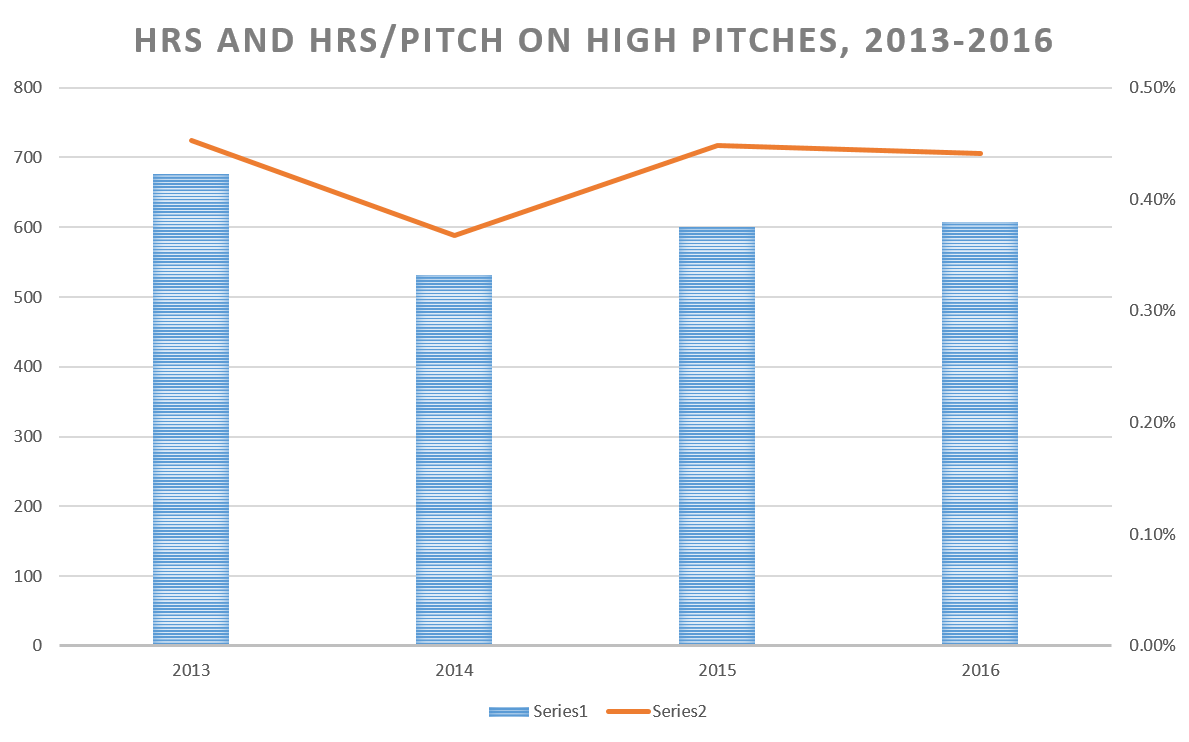
HRs and HR/P 2013-16
Here’s the total number of HRs hit on high pitches, where high is defined as at least 6″ above the center of the zone. The absolute number of HRs hit on pitches in this zone has dropped, and while the rate of HRs per pitch is fairly high, it’s not rising, and is actually a bit below rates from 2013, a low-run-scoring season. Compare that to the trend for *low* pitches. Here, in a single chart, is the story of the HR glut in baseball:
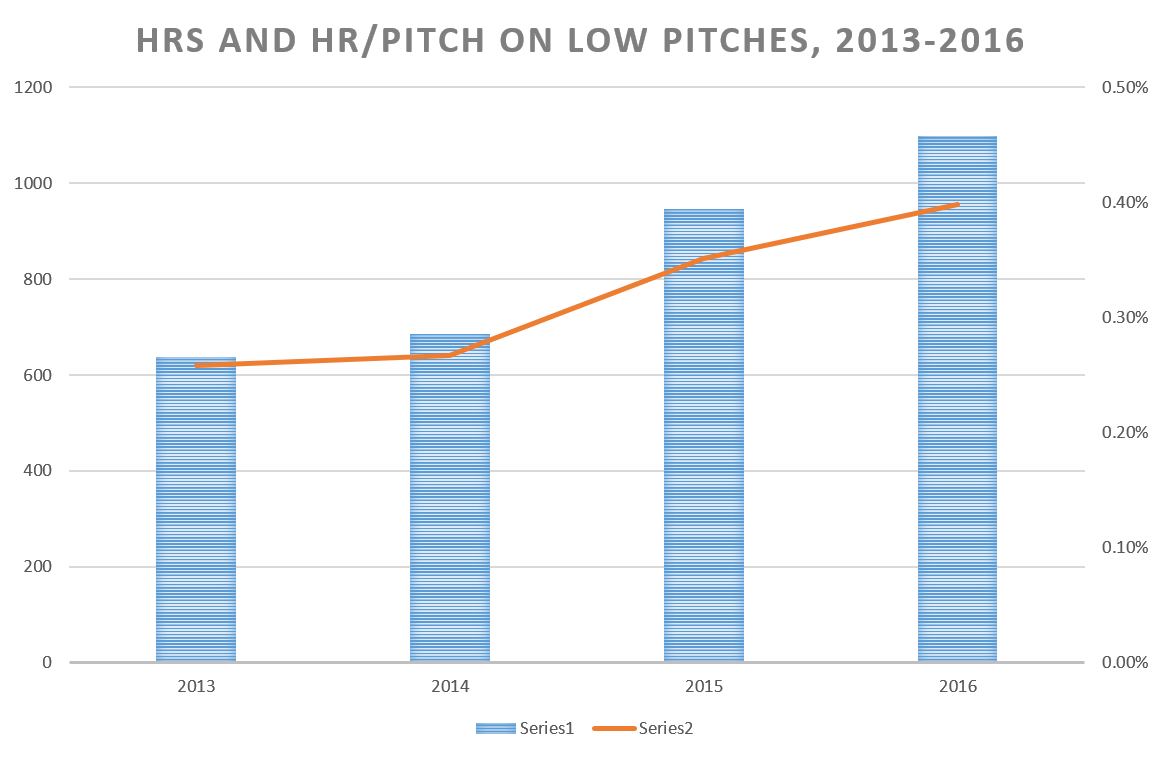
HRs and HR/P 2013-16
The absolute number of HRs hit on pitches 6″ *below* the center of the zone starts off far lower than the high pitches, but it blows past the high pitches in 2015, and it keeps growing. On a per-pitch basis, the rate’s now approaching the same rate as the high pitches, and remember there are far, far more pitches thrown in the low zone; in 2016, two pitches came in the low zone for every one pitch in the high zone. If that’s too broad, we’ve re-done the analysis using Statcast’s new detailed zones and eliminated wide pitches. If anything, the results are even more stark. HR/P in the lowest zones increased markedly between 2015 and 2016. The data are clear: if you want to avoid HRs, and remember that avoiding HRs means avoiding runs-allowed, you need to target pitchers who pitch up in the zone. Batters have gone all-in on the low pitch, and their swings are tailored to damage these pitches specifically. Pitch up, and you gain increase whiffs and decreased batting average against, while the big drawback of pitching up – namely, a much higher SLG%-against- isn’t really there anymore. You should look at guys like Drew Smyly, and we definitely need to get the message to Felix.
I’ll be honest, there’s a potential problem. If something meteorological or otherwise has happened and Safeco is now an especially EASY park to homer in instead of an incredibly difficult one, then this could backfire. But that’s crazy, right? It’s still at sea level, right by Puget Sound and that thick marine layer. Yes, HRs spiked there in 2016, but all the statcast park factors say it’s a pitcher’s park. It’s a risk, but it’s not a crippling one. Oh, almost forgot: to really maximize the value of Safeco and pitching up, we need a really athletic, Kansas City Royals-style outfield. BABIP-against is going to be pathetically low, and that can mean that even if injuries happen, our depth guys will look better than their raw stuff or FIP would predict.
:2017 Season happens:
Sssoo, I got your e-mail, and yes, I’ve updated the charts I shared back in January with 2017 data. I…I don’t know..there are many possible..what? Right, right, yes sir. Uh, high pitches:
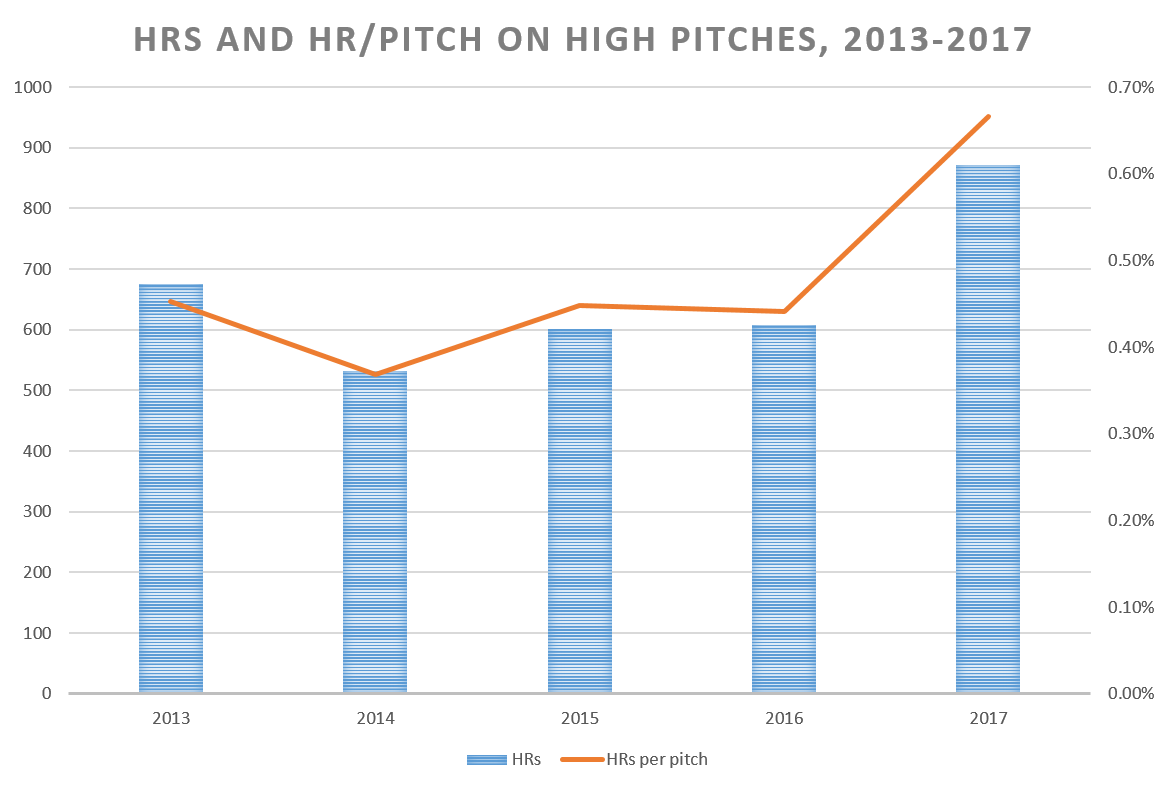
Ooops
Yes, the giant leap in 2017 does rather catch one’s eye. Ok, low pitches now:
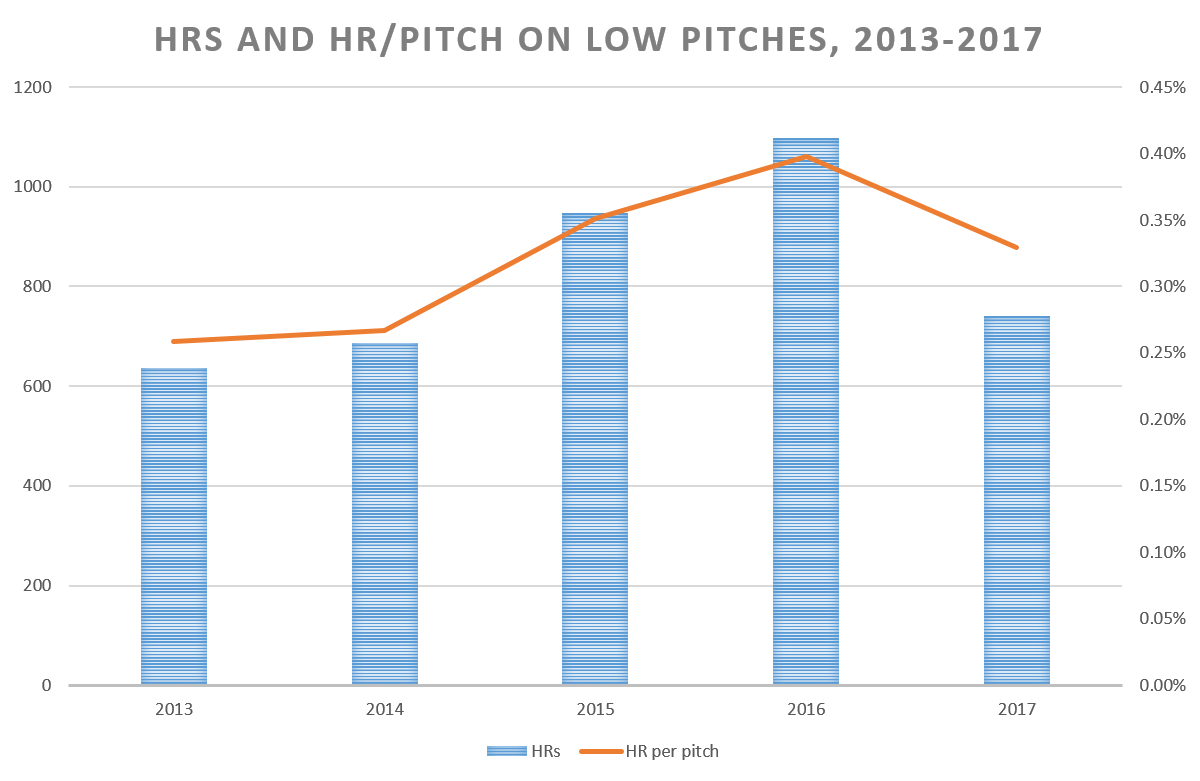
OOps
Sooo, the bit about the HR revolution being localized may, and I stress that this is all preliminary and that we need much more data, MAY have been overstated. Perhaps. It would…appear, that batters are now better at elevating and punishing pitches of all types, but that in 2017, they’ve done the most damage on, uh, pitches that are thrown, um, rather higher. It’s the damndest thing.
I said that the risk was that Safeco became truly HR-friendly, and while it’s seen a ton of HRs, I’d like to point out for posterity that our pitchers have given up far more HRs on the road. Safeco hasn’t been the issue. I would also like to point out that our ERA really is better than our FIP, and that Jarrod Dyson and company can really go get it, and it is amazing to watch. Bloggers who worried about there not being enough fly balls in play have been thoroughly shamed, as I suspected. Ha! What’s that? Our team fWAR from pitchers? Yes, 7.5, 25th in the league. There’s clearly room for improvement. Our HR/9 ranks 28th, and no, I didn’t see that coming; very sorry, sir. I really, really thought we had this whole fly-ball revolution thing sussed. Won’t happen again; I’m already for looking for new trends, and hoping they are much longer lived, sir.
————————————
I’ve been frustrated with the M’s this year, and their lack of consistent pitching that goes far beyond the injuries they’ve suffered. Sam Gaviglio just pitched a gem for the Royals as I wrote this, while the M’s struggled to get anything from higher-tier prospects and trade targets. The key has been the HR ball; the M’s have given up way too many, and it’s killed their playoff hopes. I sometimes find myself damning the front office for this, or for failing to really understand what was going on in baseball generally and at Safeco in particular: you couldn’t count on running a low HR/FB ratio, not in 2017 anyway. Great strategy for 2010, Jerry. From what I’ve heard of his talk at LL night, Dipoto seemed to admit as much.
But the more I’ve thought about it, the more I would’ve said the exact same thing as the unfortunate baseball-ops intern in the hypothetical above. Hell, I *did* say as much in that post about Felix. This really did seem like a change in how batters attacked pitches in a specific location. And then this year, all of the sudden, it wasn’t. Jeff has a post today about baseball moving away from the sinker, and a correlated fact came through in my research: pitchers are throwing fewer low pitches this year. It makes some sense, as the strike zone’s no longer expanding to the south, and as more and more have become aware of hitters’ increasing propensity to turn low pitches into souvenirs. I have no real explanation for their sudden increased ability to swat high pitches for HRs; it’s come much too late to have anything to do with the ball, which seems to have changed earlier on. And the ball itself wouldn’t explain the DROP in HR/pitch on low pitches from 2016 to 2017. This is a shift in where batters are doing damage, a reversal of a similar (inverse) shift a few years ago.
I have no idea why this is happening, or if it’ll continue next year. What I can say is that I understand the motivation behind the M’s offseason a bit more, and I have to admit that my own writing and surmising would’ve been supportive. There was no real clear sign of danger, beyond the traditional “the HR/pitch rate is high up in the zone.” This may be the result of the human tendency to find patterns in random variation, and it may be the result of a shift in batting instruction. Whatever the cause, the M’s identified what they saw as a potential improvement, and they implemented it well. I’ve been extremely critical of this FO’s ability to implement its own plans, but credit where it’s due: they set out to increase fly balls and improve OF defense, and they have absolutely done that. But they had no idea that they were walking into an ambush – that baseball would see a spike in HR/FB just as they successfully developed a fly ball staff. No one ever said being a GM was fair, but…damn. Tough break, Jerry.
Game 140, Astros at Mariners
Andrew Moore vs. Lance McCullers, 7:10pm
A day after getting to face Justin Verlander in his first start in an Astros uniform, the M’s have the honor of welcoming Lance McCullers back to the majors to make his first start in over a month. After spending the first half of the season as one of the league’s premier starters, McCullers struggled mightily in July, and then, after giving up 5 runs in 5 IP, he went on the DL with back issues. This isn’t new for McCullers, who’s essentially a more southerly James Paxton: dominant when healthy, but frequently unhealthy. That DL stint that cost him August was his 2nd of the season, and he’s missed tons of time in previous seasons as well. Paxton and McCullers have pitched an eerily similar number of innings over the past 3 years, 307+ to 312+.
Sooo, Andrew Moore. The M’s announced he was coming up to bolster the bullpen, but after using Marco Gonzales in long relief the other day, Moore will get another opportunity to start. With so many of the M’s depth options, I’ve advocated using the Yankee (and Astros!) strategy of throwing a blizzard of breaking balls to maximize effectiveness. McCullers throws his slurvy curveball more than any of his pitches at over 40%, for example. Well, Moore should not do that. He’s given up 5 dingers on his rising four-seam fastball, but it’s been a decent pitch overall. Not great, mind you, but not disastrous, which is the only way to describe what’s happened when he’s thrown other pitches. His whiff rate is better on his straight four-seam fastball than it is on his curve, which simply doesn’t generate enough break. His slider and change are a bit better at generating whiffs, but batters have put more of them in play, and they’ve put more of them in the air (the change especially). It’d be nice to see if he can modify his usage of the change to get more below-the-zone swings on it.
1: Segura, SS
2: Alonso, 1B
3: Cano, 2B
4: Cruz, DH
5: Seager, 3B
6: Haniger, RF
7: Gamel, LF
8: Zunino, C
9: Heredia, CF
SP: Moore
Ariel Miranda was effectively wild last night, walking 6 in 6 innings, but holding the Astros hitless through 6 before giving up a decisive 2-run HR in the 7th. That’s his second game this year where he’s walked 6, and it marks his 5th start giving up *at least* 4 walks. But in those 5 starts, covering 26 2/3 IP, he’s given up a total of just 2 home runs. By contrast, he’s given up zero walks in 4 starts, covering a total of 20 innings. And in *those* games, he’s given up 9 dingers, or 4.05 HR/9. His HR/9 in the high-walk games is a very un-Miranda-like 0.7.
Shawn O’Malley was DFA’d in the series of moves that enabled Rainiers IF and ex-White Sox player Gordon Beckham to earn a 40-man spot and a place on the M’s bench. O’Malley made it through waivers and was outrighted to Tacoma, whose season is over. Hmmm. “Shawn, please report to Tacoma…and when I say “Tacoma,” I mean “anywhere but here.” See you next year, possibly.”
Fangraphs’ David Laurila had a post talking about M’s relief prospect JP Sears, the guy with the incredible K rate stats in Everett and Clinton; it’s worth a read.
Speaking of Fangraphs, their playoff odds now give the M’s just shy of a 5% chance. Darn. BP’s odds have been more bullish on the M’s chances this year, but no longer; their odds are fractionally lower than Fangraphs’ now.
Game 139, Astros at Mariners
Ariel Miranda vs. Justin Verlander, 7:10pm
It’s not enough that the M’s can’t really compete with the Astros, or that they enter play tonight 15.5 games back of Houston in the AL West standings. No, tonight the M’s get to play host to Justin Verlander, who makes his debut as a member of the Astros rotation. It’s a twist of the knife not to the M’s fans who wanted the M’s to get JV instead – I don’t think it would’ve been a great move, and I’m not sure the M’s could’ve swung it – but to the front office, to see a divisional rival setting up their rotation and bullpen for playoff series, not a bid to make the wild card game. It’s September, and the M’s are on the periphery of the playoff race, and I should be happier about that, but 1) they’re miles and miles away from the Astros/Indians, and 2) there is ash literally falling from the sky like snow in much of the Northwest and the world just seems more tenuous and fraught than ever.
Ariel Miranda’s the only Mariner to make each start in the rotation. Normally, you’d hate that a guy with a FIP of *5.60* is Mr. Durability for the year, but then you’ve seen some of the M’s 6th-12th starter options. This is Houston’s *5th* game against Miranda this year, but hopefully they’ve forgotten him, as it’s been about 6 weeks since last they met. Miranda desperately needs to keep the ball in the park, but that may be harder than normal given the high gametime temperature today – the ball flies further in warmer weather.
Ex-TB Ray Ryan Garton threw an inning the other day, and while another righty 6th inning guy isn’t too noteworthy, the movement on his pitches looks interesting. He throws a cutter-ish four-seam fastball that actually has gloveside break of about 1″, and the most truly “12-6” curve I’ve seen.
Today, the M’s have recalled 1B Dan Vogelbach, who had a solid 2nd half in Tacoma, and they’ve also activated newly-acquired OF Jacob Hannemann, whom they just picked up off of waivers from the Cubs. Hannemann is your classic speed/defense guy; he’s struggled at the plate in the minors, but his defense boosted him to the back end of the Cubs top 30 prospect lists. He’s swiped nearly 30 bags this year, so he could have some value as a pinch runner down the stretch. But wait, you say: this sounds an awful like the profile of the two high-minors CF prospects the Mariners already have, and who greased the skids for the DFA of Leonys Martin: Ian Miller’s in AAA Tacoma and is more of a 40-50 stolen base threat kind of guy. And Braden Bishop makes more contact and plays brilliant defense, and he’s waiting for the Arizona Fall League to start. All of this is true, so it’s a bit odd, but I think the plan must be to get Bishop more experience against high-minors arms before throwing him to the wolves. Bishop isn’t in the same league as a baserunner as Hannemann and Miller, as well. Miller would make the most sense, but then he’s had a rough go of things in the PCL after starting off with a 12-game hitting streak. His walk rate’s fallen and when his BABIP dropped, it killed his batting value. Still, all of these players are plagued by a dearth of power – Miller’s problem is the most acute, while Hannemann is the best bet to run an ISO north of .100 (a low bar, I know). The problem is that Hannemann’s also the best bet to post an ugly K rate. Bishop would seem like the best option from that point of view, so then things like the timing of adding players to the 40-man comes into it. We’ll have to see how this plays out in the offseason, and if Miller gets added to the rotation or if Hannemann acts as the last-in, first-out guy on the 40-man, and yields his place to the next waiver claim Dipoto makes. Bishop’s probably the guy who’s most clearly in the team’s longer term plans, but it can’t feel good to see the club get a player very much like you and have that guy instantly move to the active roster in Seattle.
1: Segura, SS
2: Alonso, 1B
3: Cano, 2B
4: Cruz, DH
5: Seager, 3B
6: Haniger, RF
7: Gamel, LF
8: Zunino, C
9: Heredia, CF
SP: Miranda
Game 138, Astros at Mariners – Checking In On M’s Newest Pitchers
Erasmo Ramirez vs. Dallas Keuchel, 3:40pm
The M’s continue their homestand by hosting the first-place Astros. The Astros were in on several players at the deadline, and after failing to land any of them, made a big splash later in August by acquiring Justin Verlander and reliever Tyler Clippard, and then getting OF Cameron Maybin as well. Houston got off to a scorching start to the year, with Dallas Keuchel looking like he’d recaptured his Cy Young form from 2015, Lance McCullers was untouchable at times, and Chris Devenski was making a bid for a historic season out of the bullpen. Then things fell apart for a while: Keuchel hit the disabled list for a few months, McCullers was awful and then hit the DL (he hasn’t pitched in over a month, but he’ll be activated for this series), Devenski fell back to earth, and top prospect Francis Martes came up and struggled. It’s easy to say that the Astros depth saved them, as pitchers like Brad Peacock held the fort until the injured were ready to pitch again. But it’s worth noting that there was nothing spectacular about the depth that they’ve used: Brad Peacock’s preseason ZiPS projection was essentially identical to Christian Bergman’s, and worse than Max Povse’s. The story of the Astros’ rise isn’t just about high draft picks; Carlos Correa’s been great, but HE’S missed a bunch of time, too. Rather, it’s how much production they’ve squeezed out of the kinds of minor acquisitions that the M’s have made dozens of this year. Collin McHugh was a waiver claim. Peacock was a throw-in in a deal with the A’s. Jose Altuve was ignored by many because of his stature, Chris Devenski was a PTBNL, and Charlie Morton was signed to a two-year deal for a bit more than Marc Rzepczynski got. Their pro scouting group seems to know what it wants, and their player development staff seems to know how to turn those skills/attributes into MLB production. If I sound a bit jealous, I am.
The M’s seem to know what they want, but turning things like “fly balls, but not HRs” into on-the-ground production is hard. I’m sympathetic to the argument that ground ball pitchers are now costlier to acquire, but then I see a guy like Erasmo Ramirez, whom the M’s acquired for very little and who IS an effective GB% hurler. And as soon as he came to Seattle, the M’s seem intent on reducing his GB ability. I talked about the uptick in his four-seam usage back in mid-August, but with that month complete, we have a better idea of what’s it’s done to his batted ball profile: August saw his second-highest fly ball rate of any month since 2014. If the M’s wanted him to avoid GBs, then I guess job well done and all, but then it seems odd to lament the fact that ground ball pitchers cost more than you can afford. Erasmo’s change-up movement looks a bit different too, and less likely to get either whiffs or grounders, but I will say that sequencing a four-seam and change seems better than just sinkers/change-ups; the movement on them is too similar, and Erasmo’s velocity difference isn’t big enough.
Speaking of recent acquisitions, the M’s finally got to see RP Shae Simmons make his M’s debut in yesterday’s win. Lookout Landing’s John Trupin had a great article/interview with him that posted today, and he notes that Simmons’ command isn’t quite back to normal after his injury woes. Simmons throws his fastball very hard, at 95-98, and sat at 96+ yesterday. It’s always been a very odd duck – not a sinker thanks to very little horizontal movement, but with sinker-like “rise”. In all, I’d call it most similar to a cutter, but it’s not a textbook cutter, either. Whatever you call it, with sinking action and plus velocity, it looks pretty good. He pairs it with a slider in the mid-low 80s, and with his low release point, it moves an awful lot like Carson Smith’s, a point Trupin notes. He used to throw a split-change that looks like a great complement to his fastball, but he didn’t throw it yesterday – instead, he debuted a NEW pitch – an actual cutter that comes in about 6-7 MPH slower than the fastball, and has less vertical drop than the true slider. Compared to where Simmons was when he debuted in 2014, his fastball was even straighter and with more rise, and his slider was slower with more horizontal run. He seemed to be releasing the ball a bit higher, which may account for the movement on his fastball, but we’ll have to see more of him to know for sure.
1: Segura, SS
2: Haniger, RF
3: Cano, 2B
4: Cruz, DH
5: Seager, 3B
6: Valencia, 1B
7: Zunino, C
8: Heredia, CF
9: Motter, LF
SP: Erasmoooo
Today’s the final day of the MiLB season; it hasn’t been a great one overall for the M’s, but Modesto’s first half qualifies them for the Cal League playoffs. Tacoma ends up their campaign in Las Vegas today, while Arkansas hosts NW Arkansas (who I swear they’ve played roughly half their games against), Modesto hosts Visalia, while Clinton’s in Burlington. Modesto’s the only affiliate to end with a better-than-.500 record.
Fittingly for a post titled like this one, the M’s have added a new pitcher since I began writing today. They picked up RHP Seth Frankoff off waivers from the Cubs, along with OF Jacob Hanneman. David Phelps has been moved to the 60-day DL, ending his season, and Zac Curtis has been DFA’d.
Game 137, Athletics at Mariners – Why Don’t they make the Entire SEASON Out of A’s Games?
Andrew Albers vs. Daniel Gossett, 1:10pm
By all accounts, yesterday’s Lookout Landing Night was a success, and I hear Jerry Dipoto was a gracious and funny panelist. Nathan Bishop was on the panel, and said that this was his big takeaway from the night: “this FO’s plan was absolutely built on a pre-flyball revolution model, and they’re still scrambling because of it.” That explains a lot, and it’s something we’ve talked a lot about on the blog – the fact that Safeco became a much, much more HR-friendly ballpark and then the entire league context changed as well. I completely understand being blindsided by the late-2015 dinger explosion, or the 2016 Gotterdingerung, when Safeco saw the most HRs of any park in baseball. It’s slightly *less* understandable to be taken aback by all the homers your pitching staff gives up in 2017, when the team’s response to 2016 was to attempt to become even more fly ball oriented. You understand it from a BABIP point of view, and getting Jarrod Dyson was key to that. But it’s also hard to claim to be surprised stocking up on low-strikeout, high-fly-ball pitchers would lead to a bunch of HRs flying out of Safeco field. We all witnessed 2016; what’s happened this year didn’t come out of nowhere.
I understand that low-HR, high-K pitchers are universally valued and may cost more in talent and dollars than the M’s want to spend, but as Bishop says, they’re not exorbitant if you develop them yourself. Further, I think the most important thing in the forensic analysis of 2017 isn’t fighting over how much bad luck the M’s had (the Angels and Mets had it much worse). Instead, it’s figuring out why the pitchers the M’s targeted or developed haven’t fared as well as their projections would’ve predicted. Why was Gallardo bad? What happened to Andrew Moore? Or Marco Gonzales (last night’s long relief gem excepted)? Why have Paul Blackburn and a host of the prospects the M’s traded away flourished? Whether the M’s shift their pitching strategy or not in light of the HR revolution is irrelevant if they still have trouble implementing it.
Daniel Gossett’s a low-K, high-HR-allowed pitcher with excellent control coming through the A’s system, but who’s been beaten to a pulp by the American League. If this sounds like Dillon Overton, I completely agree. The A’s had a ton of these guys in the past few years, from Overton to Daniel Mengden to Chris Smith. They’ve all faceplanted in MLB after varying degrees of success in the PCL (Mengden in particular was great for Nashville, but he’s been the worst in MLB). I guess it’s nice to see that this phenomenon isn’t limited to Mariners prospects.
1: Segura, SS
2: Alonso, 1B
3: Cano, 2B
4: Cruz, DH
5: Seager, 3B
6: Haniger, RF
7: Gamel, LF
8: Heredia, CF
9: Ruiz, C
SP: Albers
Game 136, Athletics at Mariners – Roster Moves and Lookout Landing Night
Yovani Gallardo vs. Jharel Cotton, 6:10pm
As mentioned yesterday, the A’s offense hasn’t been too bad. They’re not great defensively, but they’ve hit the ball hard, and they’re doing it with a lot of homegrown young talent. The A’s are also 18 games under .500, which tells you something about their pitching staff. Sonny Gray was fine, but in a lost season, the A’s shipped him to New York to restock their farm system. Kendall Graveman started the year on fire, then got hurt and hasn’t been the same since. Andrew Triggs got off to a decent start, then needed hip surgery and was gone for the year. Jesse Hahn’s FIP is right where it was when he was an effective starter for Oakland back in 2015, but his ERA most certainly is not. Sean Manaea also started well, but, last night excepted, has been awful down the stretch. But perhaps the biggest difference between what was expected and what’s been delivered is in Jharel Cotton’s stat line.
Cotton came over in the Rich Hill trade from the Dodgers a year ago, a year after rising from the single-A Midwest League to the Pacific Coast League. Last year, the change-up specialist pitched well for Nashville after the trade, and then made 5 starts for Oakland that opened a lot of eyes. He walked just 4 in those 5 starts, and used his screwball-like change (it’s thrown at 78 MPH, the same as his curveball) to post very low BABIP rates. All of that led to a very good ERA, and while his FIP was higher (thanks to 4 HRs allowed), it wasn’t problematic. The A’s seemed to have acquired a useful middle of the rotation piece who’d be decent for years without commanding much in salary. So far, so Oakland. But instead, Cotton’s regressed in every possible way, with a FIP and ERA both well over 5. His K%’s down, and his walk rate’s soared, meaning his K-BB% has been nearly halved. His HR rate’s climbed even further, and he’s been especially bad with men on base.
His change-up’s still his best pitch, but it’s looking quite a bit worse this year. Batters had 1 single on the pitch in 2016, but they’ve knocked 9 XBHs off of it this year, and are slugging .462 on it. Perhaps worse, the A’s are doing what they seemingly always do, and are directing him to throw more sinkers and cutters. Those have come at the expense of his rising four-seam fastball at 93-94 and his change. There’s nothing wrong, theoretically, with using a cutter more against same-handed bats, but righties have hit well against it, and his sinker’s clearly still a work in progress. With a huge gap in vertical movement and velocity between his four-seam and change, Cotton seemed well positioned to either get whiffs or mis-hit contact. I get not wanting to show too much of the change and allow batters to sit on it, but Cotton’s far from the only Athletic who’s been given a pitch mix overhaul with questionable goals and results. It’s possible that the ultra-slow change was something of a trick pitch, and once batters learned to recognize it, they could feast on it. It’s possible that they’ve seen something in him that would make a sinker-heavy approach work well. But I’m suspicious.
1: Segura, SS
2: Alonso, 1B
3: Cano, 2B
4: Cruz, DH
5: Seager, 3B
6: Haniger, RF
7: Gamel, LF
8: Zunino, C
9: Dyson, CF
SP: Gallardo
With Jarrod Dyson back and rosters expanding, the M’s have made a bunch of roster moves over the past 48 hours. Leonys Martin didn’t make it through waivers a second time, and he’s been acquired by the Cubs, who’ve already brought him up to Chicago. The M’s continual shuffling of pitchers has resulted in a lot of outright assignments, as Christian Bergman was just outrighted for at least the second time. The M’s also tried to slip Sam Gaviglio through waivers, but like Martin, he didn’t make it; he’s been acquired by Kansas City.
Tacoma’s season ends on Monday, so the M’s will probably call up a few more players on Tuesday, but for today, they’ve brought up C Mike Marjama and RP Ryan Garton, both picked up in a late summer trade with Tampa, SP Andrew Moore (who’ll work out of the pen for now), and RP Shae Simmons, the intriguing reliever they got from Atlanta in the offseason and who was shut down in spring training. David Phelps is on the 10-day DL with an impingement in his elbow, which, I have to say, sounds really bad given it’s his second arm injury of the second half of the season.
Before the game tonight, the M’s are hosting Lookout Landing night with the current staff of the venerable M’s blog along with some previous writers who’ve gone on to other gigs. Nathan Bishop now writes over at Dome and Bedlam, while Colin O’Keefe and Jose Rivera were picked up by the Mariners themselves. GM Jerry Dipoto’s doing a Q and A so go ask some tough questions!
Game 135, Athletics at Mariners – Is This It?
Mike Leake vs. Sean Manaea, 7:10pm
Sorry for the delay!!
M’s fans get their first look at new Mariner Mike Leake, and it comes in an intradivisional game on a gorgeous night at Safeco. I mentioned Leake’s struggles in the second half of the season in the post on the trade, but Manaea’s having similar difficulties. On August 12th, he gave up 6 runs in just 1/3 of an inning, his 3rd straight start giving up 6 runs. His FIP in the second half is 5.51, and it’s coincided with a big drop in his strikeouts. Leake hasn’t been himself recently, but Manaea’s struggled at least as much. That tilts the odds in the M’s favor, which can help them re-start their on-again, off-again pursuit of the 2nd wildcard.
As some of you noted in comments on that Leake trade post, it really does seem like wildcard contention’s what this club’s built for. It’s an excellent point, and as much as Jerry Dipoto’s hands were tied with contracts, the minor league system, etc., it’s pretty clear that the M’s are not really attempting to become a juggernaut like the Astros, Cubs, Red Sox, Indians or whoever. Again, the M’s couldn’t really pull a White Sox or Braves-style rebuild because they didn’t really have much to sell. They couldn’t get 2-3 straight top-of-the-first-round draft picks either. They couldn’t play their top prospects, because they really didn’t have that many, and then decided to trade them all for some pitching help instead. This team, the 40-man roster, has been largely accumulated through mid- to low-level trades, and through long-term extensions and free agent deals. For a variety of reasons, there simply isn’t a Kris Bryant, a Rafael Devers/Mookie Betts, a Francisco Lindor, a Carlos Correa to build the NEXT great team around, and in that context, maybe it’s OK that they’re trying to muddle along and back their way into the playoffs for a couple of years. The question is when and how you pivot from that strategy and set about actually trying to compete with the Astros. The draft would be a good start, and evaluators have liked their work the past few years, and we could assess more of the player development staff’s work if Dipoto stopped trading everyone, but the point is it would take a pretty big change in how the club’s operated over the past couple of years. They’ve been willing to spend money, so maybe they build around a big free agent. But the timing of that’s really tough to pull off, and you’d like to have a homegrown group to complement whichever star you acquire. This season’s been kind of fun, and I think they can do something similar next year, maybe even more if Haniger stays healthy and Jean Segura recovers his first-half form, but a big change in approach and mindset is coming. It has to.
The A’s have been quietly building a pretty impressive farm system over the past year or two, and with 2017 already a lost cause, they’ve been able to play a lot of their youngsters in the second half. While top prospect Franklin Barreto face-planted and is now back in the PCL, Chad Pinder, Ryon Healy, Matt Chapman and Matt Olson have stabilized the A’s offense. In a neat inversion of Moneyball, they’re swinging for the fences and not appearing to care at all about plate discipline. Pinder and Healy have wRC+ figures of 100, meaning they’ve been league-average bats, and neither one has an OBP over .300. Chapman’s OBP is .308 and he’s been better than league average. Olson’s put up the best slash line, but his K rate is safely above 30%. These are not the Scott Hatteberg A’s – they’re Khris Davis’ team now. Sure, Boog Powell’s down there now, and he actually has a great walk rate. The A’s have a top-10 walk rate on the year, but much of that’s due to the work of veteran hitters, many of whom are gone: Yonder Alonso for one. Their team stats are pretty much the equal of the M’s – both clubs are right at league average overall. The fact that the A’s are hanging around that mark on the cheap, and with so many under 26-year-old bats, should give M’s fans pause. Yes, their pitching has been a shambles, and grades out worse than the M’s. But I would like to know why the A’s have gotten far more out of M’s cast-off Paul Blackburn than the M’s have from Yovani Gallardo, Marco Gonzales, and Adam Moore. Luck? Coaching? A more HR-suppressing ballpark?
1: Segura, SS
2: Haniger, RF
3: Cano, 2B
4: Cruz, DH
5: Seager, 3B
6: Valencia, 1B
7: Heredia, LF
8: Zunino, C
9: Dyson, CF
SP: Leake
Welcome to Seattle, Mike! The future of the team aside, all of the warning signs aside, I hope you pitch out of your mind in the last month and keep the M’s in this race.
The M’s are sending 8 prospects to the Arizona Fall League that begins play in October. They are RPs Matt Festa, Art Warren and Darin Gillies; SP Max Povse; C/1B Joe DeCarlo; OFs Eric Filia, Braden Bishop and Kyle Lewis. Lewis is the top prospect of the group, while Povse could use a good re-set to his 2017 that started so brightly. DeCarlo can presumably work on his catching a bit more, though the M’s aren’t keeping him there full time with Modesto. The prospect with the best shot at opening some eyes and perhaps changing the industry consensus about him is Bishop, the speedy CF and ex-UW Husky. A slight uptick in his power production helped him in High A, but he’s been even better at AA, dropping his K rate and keeping his walk rate above 10%. Turning into a contact+defense poor-man’s-Jarrod-Dyson (Bishop’s defense is his calling card) would be huge for the M’s, and I hope he pulls it off. Fangraphs’ prospect guy Eric Longenhagen has some comments on the M’s and every other team’s prospects in this AFL round-up post.
Mariners Get Mike Leake + Some of Mike Leake’s Contract
The M’s are at the periphery of a playoff race, and faced perhaps the worst starting pitcher in the AL today. Their own starting pitcher re-took the “lead” for most HRs allowed, but thanks to the fact that they were facing a plainly not-MLB-quality opposing pitcher, they found themselves tied (despite the fact that their starter yielded *four* HRs). After yet another injury, the M’s gave the ball – in the late innings of a tie game – to Christian Bergman. The M’s need pitchers, and they pitchers capable of giving them decent innings that can give their overtaxed bullpen a break. Ideally, they’d find someone durable enough to make each start down the stretch. Today, the M’s accomplished those goals by trading for St. Louis starter Mike Leake. The cost in talent wasn’t huge; the M’s are sending glove-first SS Rayder Ascanio east. Instead, this is essentially a deal for taking on a large fraction of Mike Leake’s contract.
Mike Leake isn’t awful, and his contract wasn’t exactly a disaster. In two years for the Cardinals, Leake’s been average or above by fWAR, but a bit worse than that by RA9-based WAR. He had about $55 million left on a deal that runs through 2020, with a club option for 2021, and thus was set to earn an average of $17M plus over his next three seasons. Given the state of the game and the state of Mike Leake, that seems pretty fair, even if fans would prefer a contract of that size to go to players a bit more exciting than Leake. Leake’s struggled of late, but fundamentally, the reason the Cards sought salary relief here goes back to 2014.
In 2012, the Cards picked a high-floor pitcher in the first round of the MLB draft. Michael Wacha would make his debut in 2013, and he’s still a fixture in their rotation. The next year, the Cards took Gonzaga pitcher Marco Gonzales in the first round – another high-floor guy who pitched well for them a bit, then struggled with injuries, and then moved to Seattle in a deal you may have heard of. In 2014, though, the Cards had two first round picks and went for pitching with both of them. With the first, they took another college-trained, high-floor guy in Florida State’s Luke Weaver. With the second (technically in the competitiveness balance picks), they went with hard-throwing high schooler Jack Flaherty. Weaver’s torn through the minors striking out far more than the maximum allowable to retain “high floor” status; he made his MLB debut last year, and has been excellent in a handful of starts in the past few weeks. Weaver went 10-2 with a 2.55 ERA in AAA this year, and he’s 3-1 with 36 Ks in 29 IP for the Cardinals. There is nothing for him to do in the minors anymore. And he’s not alone. Flaherty, still just 21 years old, was 7-2 with an ERA under 2 in AA this year, so he moved up to AAA and was 7-2 with an ERA of 2.74. Some HRs pushed his FIP higher, but Flaherty’s got top-100 prospect pedigree and a plus fastball, and thus the Cards can dream on him. With the trade of Leake, the Cards have called up Flaherty to take his place in the rotation.
The Cardinals had no need to be tied to a fairly large contract for an average-ish pitcher, not with youngsters on the way up and not with Lance Lynn hitting free agency at the end of the year. The M’s, meanwhile, were perhaps the team most in need of a competent – not great, not even good, just competent – starting pitcher (with the possible exception of the Orioles, who continue to win despite a poor rotation). From a high level, the deal makes a lot of sense. Of course, even with pitching at a premium, no one would take on the entirety of Leake’s remaining contract. Instead, the Cards will send some cash with Leake, turning that $55 M in guaranteed money into something more like $36 M. Jerry Dipoto told the TNT’s Bob Dutton that they asked themselves, “If Mike Leake is a 30-year-old free agent (in the coming offseason), and we were able to achieve this deal with him, we would be comfortable signing him to that contract?” At 3 years and ~$12 M per year, they obviously thought so, and it’s hard to argue with them. This commitment is roughly the same amount they gave Hisashi Iwakuma this year, and with ‘Kuma unlikely to return, they could use a league-average pitcher to replace him. On a per-year basis, this is a bit more than they’re giving Yovani Gallardo this year, and Leake’s projected to be significantly better.
So this is a great deal, right? I completely understand it, but there’s one big warning sign here. In the past few months, Leake’s sinker – his primary fastball – has been noticeably slower. That’s coincided with a run of bad outings and a collapse of his strikeout rate. As a ground-ball guy, Leake’s never been about Ks, but as you might expect, his K rate and runs allowed are correlated. Moving to the AL would seem to push his K rate even lower; nearly 1/5th of his career strikeouts have come against opposing pitchers, and it’s more than 20% this season. As a ground ball guy, though, he may be able to keep the ball in the park, something the M’s legion of fly-ballers haven’t been able to do. If the M’s think this velo drop is just a blip, or something that could be remedied with an extra day of rest, then I get it. But if Leake’s durability is breaking down, then the M’s are on the hook for 3+ years of Leake’s decline phase.
That velo drop comes at an inopportune time, as the M’s still fancy their chances to get the 2nd wildcard. Unfortunately, Leake’s been much better in the first half over his career:
And more troubling, not all opponents are equally adept at hitting sinking fastballs – Leake’s bread and butter pitch. The best two teams in baseball at hitting sinkers/two-seamers? Houston and Texas, two teams who’ll play the M’s 13 times next month. Jeff’s recap notes that his expected wOBA has been nearly identical in 2015, 2016, and 2017 – right around .327 each year. But since July 1, it’s risen to .371, and now he won’t get to face pitchers anymore.
His change-up’s velocity is down even more than his sinker’s, and that may account for his vanishingly low K rate against lefties this year. He’s never really had big platoon splits before, so it’s hard to know what to make of that. He’s getting more sink on his pitches with the Cardinals than he did with the Reds, but that seems to be the result of a slight lowering of his release point. He throws a slider *and* a cutter, along with a curveball he uses sparingly. At just 30 years old, there’s a scenario where he ages gracefully and gives the M’s 2-3 WAR each year of the deal and helps stabilize a rotation that could desperately use it. As a pitcher, there’s also a scenario where he velo drop continues and he washes out due to injury.
Let’s be clear: the M’s have the money to take on a good chunk of Leake’s contract. I’ve said for a while that their commitment to Robinson Cano is no reason they can’t sign other players, something they’ve demonstrated by extending Jean Segura and now acquiring Leake. Because Gallardo/Iwakuma drop off the payroll next year, and because they likely won’t pay Drew Smyly either, they still have room to add, even apart from their large commitments to Cano, Felix, Seager, Cruz, and Leake. That’s good, as they’ve obviously got a number of holes to fill, but I think it’s clear that, given the state of the baseball business, the M’s are not hamstrung by these contracts. Once they got a decent chunk of money from St. Louis (and the Cards even kicked in $750,000 of international bonus pool money), the finances of the deal make sense. The key is Leake’s health and his transition to the AL. My guess is that this move doesn’t really change the math on the 2017 playoff race, and we’ll need to evaluate it after 2018.
Game 134, Mariners at Orioles
Ariel Miranda vs. Ubaldo Jimenez, 12:05pm
It’s getaway day in Baltimore, and I think the M’s are pretty happy to put this road trip behind them. The disappointment of the Yankees series has led to two awful games in Baltimore, and now the M’s are playing to avoid a sweep in a HR-friendly park behind a HR-friendly starting pitcher. Of course, the M’s line-up has to like seeing Ubaldo Jimenez’s name, too. Ariel Miranda’s currently tied for 3rd in baseball for most HRs given up in 2017, but Jimenez, despite pitching far fewer innings, is hot on his tail. Jimenez’s HR/9 rate ranks 3rd among all pitchers who’ve thrown at least 100 IP, while Miranda’s is 9th.
Jimenez’s career is a fascinating one, as he’s gone from ace to broken shell of his former self to respectable middle-of-the-rotation reclamation story and then back to one of the worst starting pitchers in the game. After the Lucas Sims game and Dylan Bundy’s utter dominance last night, I’m a bit gunshy about talking down an opposing starter, but…just look at Jimenez’s numbers: in 126 IP, Jimenez has an ERA of 6.57 and a FIP of 5.64. That FIP is the 2nd worst in the league, and would be second worst in each year since 2015. It would rate as the worst in 2014 or 2013. In recent years – James Shields a few years ago, or Derek Holland this year – we’ve seen pitchers give up an astonishing number of HRs, which pushes their FIP (and ERA) way up near 6. But Ubaldo combines a poor walk rate with a poor strand rate and drizzles it over his long-standing inability to keep the ball in the park. All of this means that, pace Shields or even Miranda, his FIP isn’t overstating his problems – it’s actually understating them.
The M’s playoff odds are down under 10%, and their wildcard odds now rank 8th in the AL, so I’m not sure how much to talk about must-win games, but if they want to jump back into things, they absolutely need to beat Ubaldo Jimenez today. Fangraphs’ game odds give Baltimore the edge, which is pretty remarkable, but if you can’t beat Jimenez a day after getting one-hit, maybe high-stakes baseball isn’t for you. Jimenez has been particularly hurt by lefties, despite the fact that his splitter’s a decent pitch against them. Like Miranda, the problem is that opposite-handed batters really see his fastball well. Since the start of the 2016 season, lefties are slugging .739 against his sinker, his primary fastball. Righties are slugging .465, which isn’t too bad. But all of the three true outcomes are cranked to 11 against lefties – he strikes more of them out, but also walks more, and gives dozens and dozens of dingers. Good match-up for the M’s lefties today.
1: Gamel, LF
2: Alonso, 1B
3: Cruz, DH
4: Cano, 2B
5: Seager, 3B
6: Haniger, RF
7: Zunino, C
8: Heredia, CF
9: Motter, SS
SP: Miranda
A day off for SS Jean Segura, who’s been in a tailspin for a few months now.
Max Povse wasn’t sharp in his start last night against Salt Lake, walking 3 and K’ing 1 in 3 IP (the Rainiers are giving their starting pitchers 3-4-5 IP per game these days) in an 8-1 loss. Evan Scribner made a rehab appearance, pitching one scoreless inning. Modesto and Arkansas both notched wins behind strong starts from Tyler Jackson and Bryan Evans, respectively. We’ll give Jackson the nod for start of the day thanks to his 8 Ks in 5 IP. Tommy Romero got his 4th win in the AZL, and the 20-year old now has a K:BB ratio of 51:15 in 43 1/3 IP.
In bigger news, the M’s just acquires SP Mike Leake from St. Louis for cash, SS Rayder Ascanio, plus international bonus pool slot money. More on this soon.